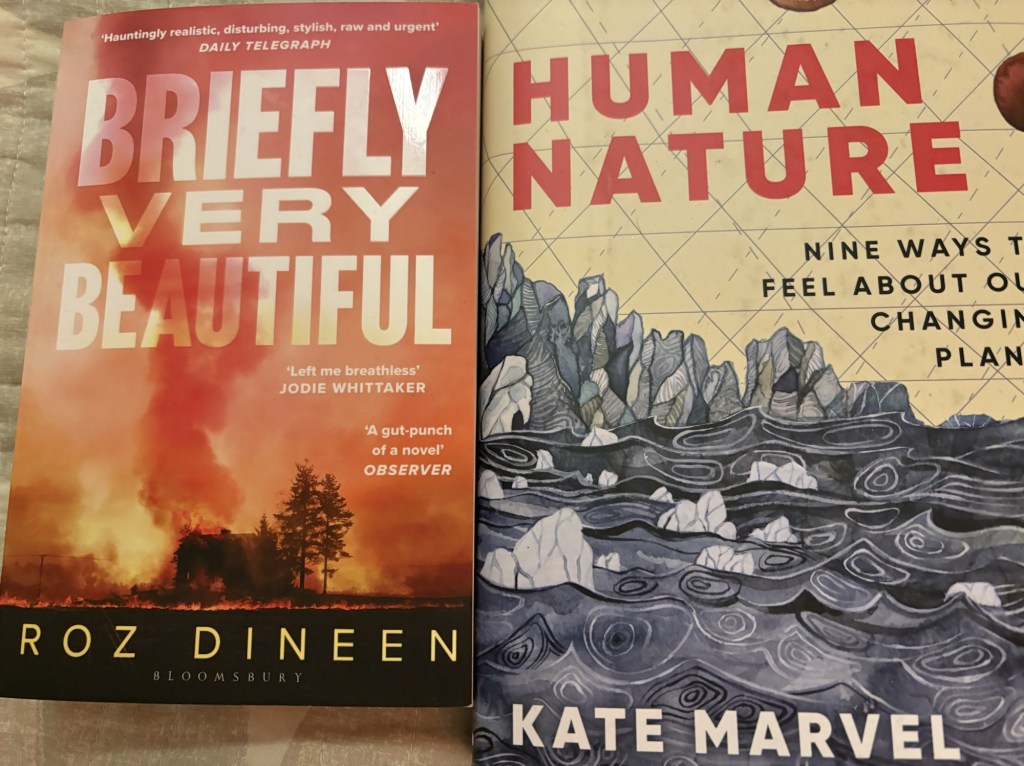
Recently, I read Human Nature by Kate Marvel and Briefly Very Beautiful by Roz Dineen almost back to back. Though very different in form and voice, reading them one after the other left me thinking about the human dimensions of climate change.
Kate Marvel is a climate scientist, and her book uses nine emotions (wonder, anger, guilt, fear, grief, surprise, pride, hope, and love) as a framework for explaining climate change, alongside stories from human history and her own life. Dineen’s book, in contrast, is a deeply personal and heartbreaking story of a mother’s love and efforts to protect her children in the face of environmental collapse.
Toward the end of Human Nature, Marvel reflects on a question many environmental professionals face: in which tone should we speak or write about climate change? I often stick to a strictly professional, emotionally neutral tone, partly because the weight of climate change and nature loss can be exhausting for people. Yet emotions are also a source of motivation and strength, and they affect whether change happens at all.
I think Marvel strikes this balance exceptionally well. Her book is one of the most compelling climate reads I’ve encountered for a while, and together with Dineen’s work, it was a timely reminder that clarity and emotion are not opposites, they are both essential.
One quote that stayed with me:
“Leaders made choices, people made mistakes, and until it happened, it might have always gone otherwise. But this is the whole point. We will never be able to do a clean experiment to isolate environmental factors from their political, historical, and societal contexts. Climate change never happens in a void. It happens to us.”
#climatechange #climatescience #climatenovel #climatecommunications #humannature #brieflyverybeautiful #environmentalchange #environmentalcollapse #emotions
 Kaarina Saramäki